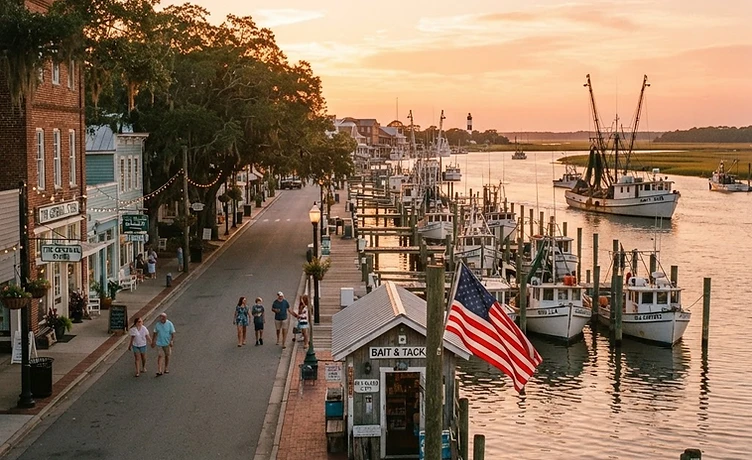
A reflection on the spirit of coastal North Carolina, the legacy of its small businesses, and why supporting local is the cornerstone of a thriving town.
There is something about Labor Day at the coast that feels different from anywhere else. The air is warm but carries a hint of what is coming. The light shifts a little earlier each evening. And the town, full all summer with visitors and vacationers, begins to settle back into the rhythm of the people who call it home year-round.
The Spirit of Life at the Coast
Coastal North Carolina has a way of teaching you what matters. Out here, the tide does not care about your schedule. The salt air does not ask whether you are busy. Life moves at the pace of the water, and the people who live here learn to move with it.
That does not mean things are slow. It means they are intentional. A fisherman heading out before dawn knows exactly why he is doing what he is doing. A shop owner sweeping the front step before opening knows that the work itself is the point. There is a pride in it, a quiet dignity that comes from building something with your own hands and your own time.
I have felt this spirit in every coastal town I have worked in, from Wilmington to Southport to the smaller communities tucked along the Intracoastal Waterway. It is not loud. It does not need to be. It is steady, the way a lighthouse is steady.
A Short History of North Carolina Small Business
North Carolina was built by small business. Long before the research triangle or the banking towers of Charlotte, there were fishing villages, family farms, and general stores. The state's earliest economies were built on tobacco, textiles, timber, and seafood, and every one of those industries started small.
In the late 1800s and early 1900s, mill towns dotted the Piedmont. Families worked the looms and lived in company houses, and the town itself grew around the mill. On the coast, it was shrimping, crabbing, and oystering that defined the working day. Boat builders, net makers, and ice houses kept the industry moving. Every link in that chain was a small business.
The textile mills have mostly gone. The fishing industry has changed. But the instinct to build something of your own has not. Today, North Carolina ranks among the top states in the country for small business growth, and a significant share of our workforce is employed by companies with fewer than fifty people. That is not a coincidence. It is a continuation.
Why Supporting Local Matters
When you walk into a local shop and buy something, you are doing more than making a purchase. You are keeping a door open. You are making it possible for someone to keep doing the thing they are good at, in the place they chose to do it.
Here is what happens when a town supports its local businesses: the money stays close. A dollar spent at a locally owned shop tends to circulate through the community two to three times more than a dollar spent at a national chain. It goes to the local printer who makes the signs. It goes to the local accountant who does the books. It goes to the family down the street whose kid plays on the same team as yours.
But it is more than economics. Supporting local is about character. A town with a main street full of independent shops has a soul that a town full of chain stores cannot replicate. The bookstore that hosts readings, the coffee shop that knows your order, the boutique that carries the work of a local artist, the hardware store where someone actually helps you find the right bolt, these are the places that make a town feel like a town and not just a zip code.
Labor Day and What It Asks of Us
Labor Day was created to honor the contributions of working people. It began in the late nineteenth century, born out of the labor movement, at a time when the country was grappling with what it meant to work and to be treated fairly for it. The first Labor Day parade was held in New York in 1882, and it became a national holiday in 1894.
I think about that history and I think about the people I know who run small businesses along the coast. They work holidays. They work weekends. They work through hurricane season and off-season and every season in between. They do not get a paid day off. For many of them, Labor Day is just another Monday, maybe a little busier than usual.
So if there is a keystone to helping a town succeed, this is it: show up for the people who show up every day. Buy the mug from the local potter. Order the sandwich from the place that has been there for thirty years. Tell a friend about the shop you just discovered. Leave a review. Bring a neighbor.
What I Have Learned From This Place
I came to coastal North Carolina from a different world. I spent years in healthcare before I found my way to real estate and home services. But the lesson is the same in both: the work is the foundation, and the people who do the work are the foundation of the work.
At SeaWeeds Home Co., I try to bring that same spirit to everything I do. When I stage a home, I am thinking about the family who will live there. When I curate a collection of decor, I am thinking about the small details that make a space feel like it belongs to someone. When I write here, I am thinking about the community of people who read these words and care about the same things I do.
Labor Day is a good moment to pause and say thank you. Thank you to the people who work the boats. Thank you to the people who run the shops. Thank you to the people who clean the houses, fix the roofs, teach the kids, and keep the lights on. You are the town.
With gratitude and a love for this coast,
Kelly Krasner
SeaWeeds Home Co.
Sources & Statistics
- The first Labor Day parade was held in New York City on September 5, 1882, organized by the Central Labor Union. U.S. Department of Labor
- Labor Day became a national holiday on June 28, 1894, when President Grover Cleveland signed it into federal law. U.S. Department of Labor · U.S. House of Representatives
- North Carolina ranked the #1 state for business by CNBC in 2022, 2023, and 2025. NC Commerce
- Small businesses account for 99.6% of all North Carolina businesses and employ over 1.7 million people. SBA Office of Advocacy
- Dollars spent at locally owned businesses recirculate through the community 2 to 4 times more than dollars spent at national chains. American Independent Business Alliance
- 48% of each purchase at local independent businesses stays in the local economy, compared to less than 14% at chain stores. UMD Labovitz School of Business
- Labor Day continues to evolve as a holiday that honors working people while shaping the future of work. AskHandle